
Build vs. Buy: The Hidden Cost of Writing Code You Could Have Rented
 Roy LevyJune 202611 min readProduct & delivery
Every hour your team spends building custom auth, billing, email, or notification systems is an hour they're not spending on the actual product.
That sounds obvious. But a lot of founders and developers still fall into the same trap:
"We can build this ourselves."
And technically, yes, you probably can.
A good developer can build an authentication system. A good developer can build a billing flow. A good developer can wire up email templates, password resets, invoice handling, admin permissions, logs, webhooks, retries, and all the boring infrastructure around it.
But the real question isn't:
"Can we build it?"
The real question is:
"Is this the best use of our limited time?"
Most of the time, the answer is no.
If you are weighing what to build first on an early product, the same tradeoff shows up when building an MVP web app and when timelines slip for reasons that are not purely technical.
The developer ego trap
Developers like building things.
That's the job. That's also the danger.
When you're technical, it's very easy to look at a SaaS product and think:
"Why would I pay for this? I can build it in a few days."
Sometimes that's true for the first version. You can build a simple auth flow in a few days. You can build a basic subscription table in your database. You can send transactional emails with a simple SMTP setup. You can create a quick notification system.
But that first version is not the real cost.
The real cost comes later, when the "simple" thing starts acting like a real product. Password reset emails land in spam. A Stripe webhook fails and a customer doesn't get access. A user changes their email and your permissions logic breaks. Your notification system suddenly needs retries, logs, preferences, unsubscribe rules, and admin visibility.
I've seen this happen in real projects. A team starts with a "simple" custom system because paying for another SaaS tool feels wasteful. A few months later, that system has retries, permissions, admin screens, logs, support issues, and strange edge cases nobody planned for.
At that point, it's no longer a small internal feature.
It's a product inside the product.
This is a cousin of resume-driven development—building because it feels technically satisfying, not because the business needs it yet.
"Free" custom code is not free
A lot of founders compare build vs. buy in the wrong way.
They look at a tool like Stripe, Clerk, Auth0, Resend, Postmark, or Intercom and think:
"This costs $50, $200, or $500 per month. We can save money by building it."
But they forget to price the developer time.
Let's keep it simple. If a developer costs your business $60 per hour, and a custom internal system takes 80 hours to build, that's already $4,800.
And that's only the first version.
Now add bug fixes, edge cases, security updates, customer support, documentation, monitoring, maintenance, future refactors, and onboarding new developers into that codebase.
Suddenly, the "free" internal tool is not free at all.
It's just a SaaS subscription you pay for with your own team's time.
And your team's time is usually the most expensive thing you have.
Especially in an early-stage product.
The same math shows up when teams skip polish on the core and pay later—something I break down in the hidden cost of quick and dirty code. That tradeoff is also where senior full-stack product development actually earns its money: knowing what to rent now so the core can ship.
Core vs. context
A simple way to think about build vs. buy is this:
Build the core. Buy the context.
Your core is the thing customers actually choose you for.
Your context is everything your product needs in order to exist, but that doesn't make the product special.
For example, if you're building a dental clinic SaaS, the core might be appointment workflows, patient history, treatment notes, clinic-specific reporting, and the exact way clinics manage their day.
That's the product.
But login, billing, transactional emails, password resets, file storage, and basic analytics are probably not the reason a clinic chooses you. They need those things to work, but they don't care if you built them from scratch.
In fact, they probably prefer that you didn't.
Because proven tools are usually more reliable than custom code written under pressure.
Things you should usually buy first
In most early-stage products, these are not worth building from scratch.
| Feature | Better starting point | What you're actually buying |
|---|---|---|
| Payments | Stripe, Paddle, Lemon Squeezy | Failed payment handling, invoices, receipts, tax logic, disputes |
| Authentication | Clerk, Auth0, Supabase Auth, Firebase Auth | Sessions, password resets, MFA, user management, security edge cases |
| Transactional email | Resend, Postmark, SendGrid | Deliverability, logs, retries, domain reputation |
| Error tracking | Sentry | Visibility into bugs before users complain |
| Analytics | Plausible, PostHog, Mixpanel | Product behavior data without building dashboards |
| Customer support | Intercom, Crisp, HelpScout | Inbox workflows, chat history, support tooling |
| File storage | S3, Cloudflare R2, Supabase Storage | Reliable storage, permissions, scaling, CDN support |
| Scheduling and jobs | Trigger.dev, Inngest, cron services | Retries, background jobs, logs, failure handling |
Building auth or billing from scratch to save on SaaS? I help founders scope what to rent vs. build on early products—see full-stack web development for how I work on SaaS builds.
You can always replace tools later.
But in the beginning, speed matters more than perfect ownership. The goal is not to create the cleanest internal architecture in the world. The goal is to get the product into real users' hands.
On NichePressa, the core was AI-assisted publishing and GitHub workflow—not login, billing, or email infrastructure. Stripe, Supabase Auth, and Sentry handled the context so the product could ship.
The danger of building too early
The worst time to build custom infrastructure is before you fully understand your product.
At the start, you're still learning. You don't know which customers will stay, which features matter, or which workflows are actually painful. You don't even know what pricing will work yet.
So if you build too much custom infrastructure too early, you're probably building around assumptions.
And assumptions change.
That's how teams end up with complex internal systems that no longer match the product. They built too much before the business was clear.
I wrote about that broader pattern in the most expensive mistake I keep seeing in software projects—building before the problem is clear.
This is especially dangerous for solo founders and small teams. You may feel productive because you're writing a lot of code, but writing code is not the same as making progress.
Progress means learning faster, not just writing more code.
Buying is not weakness
Some developers treat third-party tools like cheating.
It's not cheating.
It's leverage.
Stripe is not just payment forms. It's cards, invoices, tax logic, failed payment handling, webhooks, disputes, compliance, hosted checkout, receipts, customer portals, and years of painful edge cases.
Resend is not just "send email." It's deliverability, domains, logs, retries, templates, and reputation.
Clerk or Auth0 is not just login. It's sessions, password resets, social login, organizations, MFA, security rules, and user management.
You're not paying because you're unable to build it.
You're paying because you have better things to build.
That's a very different mindset.
When it does make sense to build
This doesn't mean you should buy everything forever.
There is a point where bringing something in-house makes sense. But it usually comes later, after the product is working and the business has clearer needs.
Building makes sense when the feature is central to your product, the third-party tool blocks important workflows, the SaaS cost is hurting your margins, and your team has enough time to maintain the custom version properly.
For example, if billing is a major part of your product's unique value, you may eventually need more control. If notifications are deeply tied to your product's behavior, maybe a custom notification engine makes sense. If a third-party tool becomes too expensive at scale, replacing it can be a smart move.
But that decision should come from real usage, not ego.
Don't build because you might need control one day. Build when the lack of control is already costing you.
When that tipping point actually arrives, the rewrite vs. refactor decision gets expensive fast if you have not planned for it.
The tipping point
A good rule:
Don't replace a third-party tool just because the monthly bill feels annoying.
Replace it when the cost of the tool is clearly higher than the cost of owning the system yourself.
And owning means everything: building it, testing it, securing it, monitoring it, fixing it, documenting it, supporting it, and improving it over time.
A $500/month SaaS bill may look expensive. But if replacing it takes one developer a month, plus ongoing maintenance, it may take a long time before you actually save money.
The tipping point usually arrives when three things are true:
- The tool is expensive at your current scale.
- Your needs are stable and well understood.
- Building your own version gives you better margins, better product control, or a stronger user experience.
Until then, renting the boring parts is usually the smarter move.
A simple build vs. buy checklist
Before building something from scratch, ask:
- Is this part of our core value?
- Will customers choose us because of this feature?
- Is there a mature tool that already solves 80% of the problem?
- What happens if this breaks?
- Who will maintain it in six months?
- How much product progress do we lose by building this now?
- Are we building this because it's truly needed, or because we want control?
That last question matters.
A lot of bad technical decisions hide behind the word "control."
Control sounds responsible. But too much control too early can slow you down.
If you are deciding what to build first, the same clarity-before-code mindset applies when you plan a web application build.
The founder version
For founders, the mistake is usually trying to save money in the wrong place.
You want to avoid SaaS subscriptions, so you spend developer time instead. But developer time is runway.
Every week spent building commodity infrastructure is a week not spent testing the product, talking to users, improving onboarding, closing customers, or finding the real market.
For SaaS founders specifically, what to look for when hiring a SaaS developer includes whether they default to building commodity infrastructure or shipping core value.
A startup doesn't die because it paid for a few useful tools.
A startup dies because it moved too slowly, learned too slowly, or spent too much time building things users didn't care about.
The developer version
For developers, the mistake is usually pride.
We want clean systems. We want control. We want to avoid ugly third-party limitations. We want to build it "properly."
That instinct is useful when applied to the right problems.
But it can be harmful when applied everywhere.
A strong engineer doesn't build everything.
A strong engineer knows what not to build.
That's often the more mature decision.
Rent the boring parts
There's nothing wrong with writing custom code.
The problem is writing custom code for problems that are already solved well enough.
Your product doesn't become better because you built your own auth system. It becomes better when users can do the thing they came for faster, easier, and with fewer problems.
So build the parts that make your product different.
Buy the parts that make your product work.
And only bring things in-house when the business has earned that complexity.
That's the real build vs. buy decision.
Not:
"Can we build it?"
But:
"Is this the best use of our limited time?"
See how I approach full-stack product development or contact me if you want help deciding what to build first.
Related posts
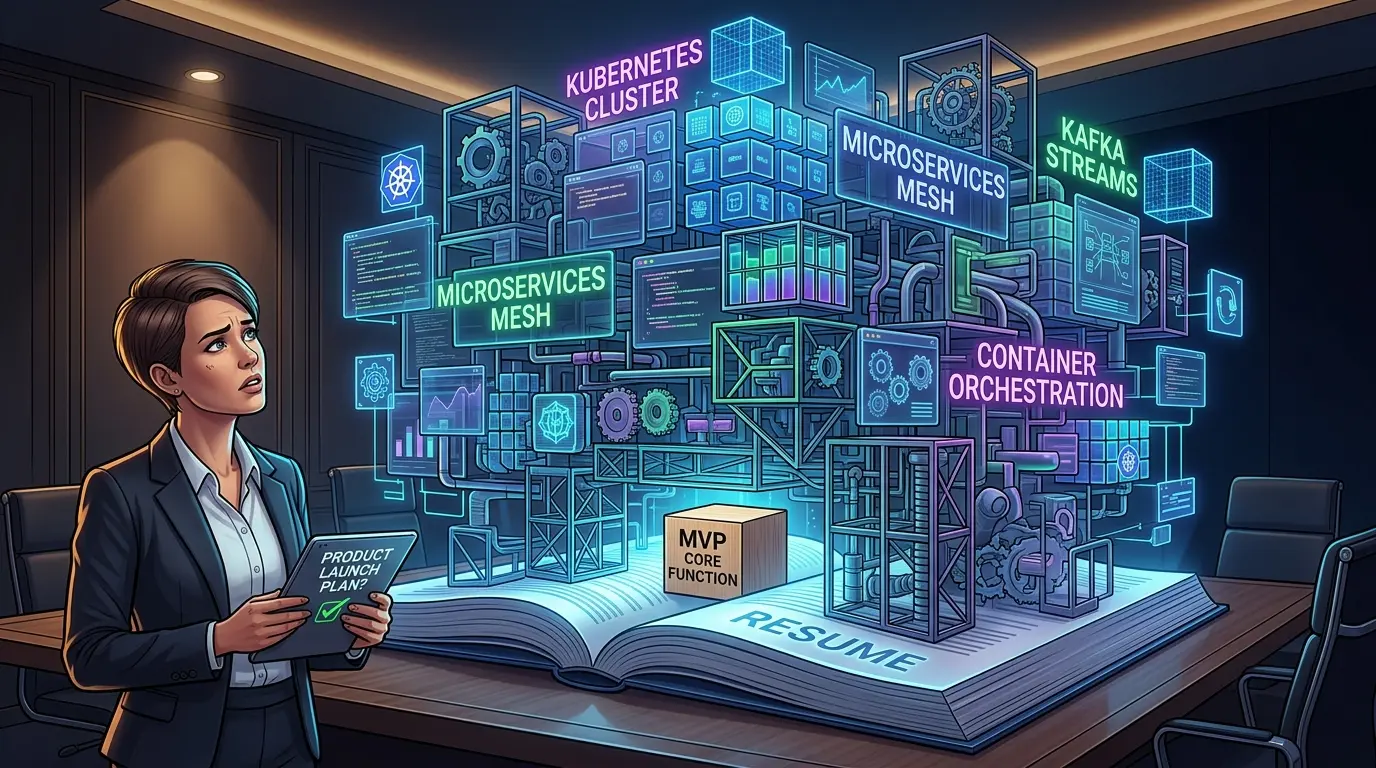
Resume-Driven Development: Is Your Team Over-Engineering Your MVP?
May 202614 min readSlow MVP development is not always caused by product complexity. Learn how resume-driven development leads to over-engineering, bloated infrastructure, and delayed launches.
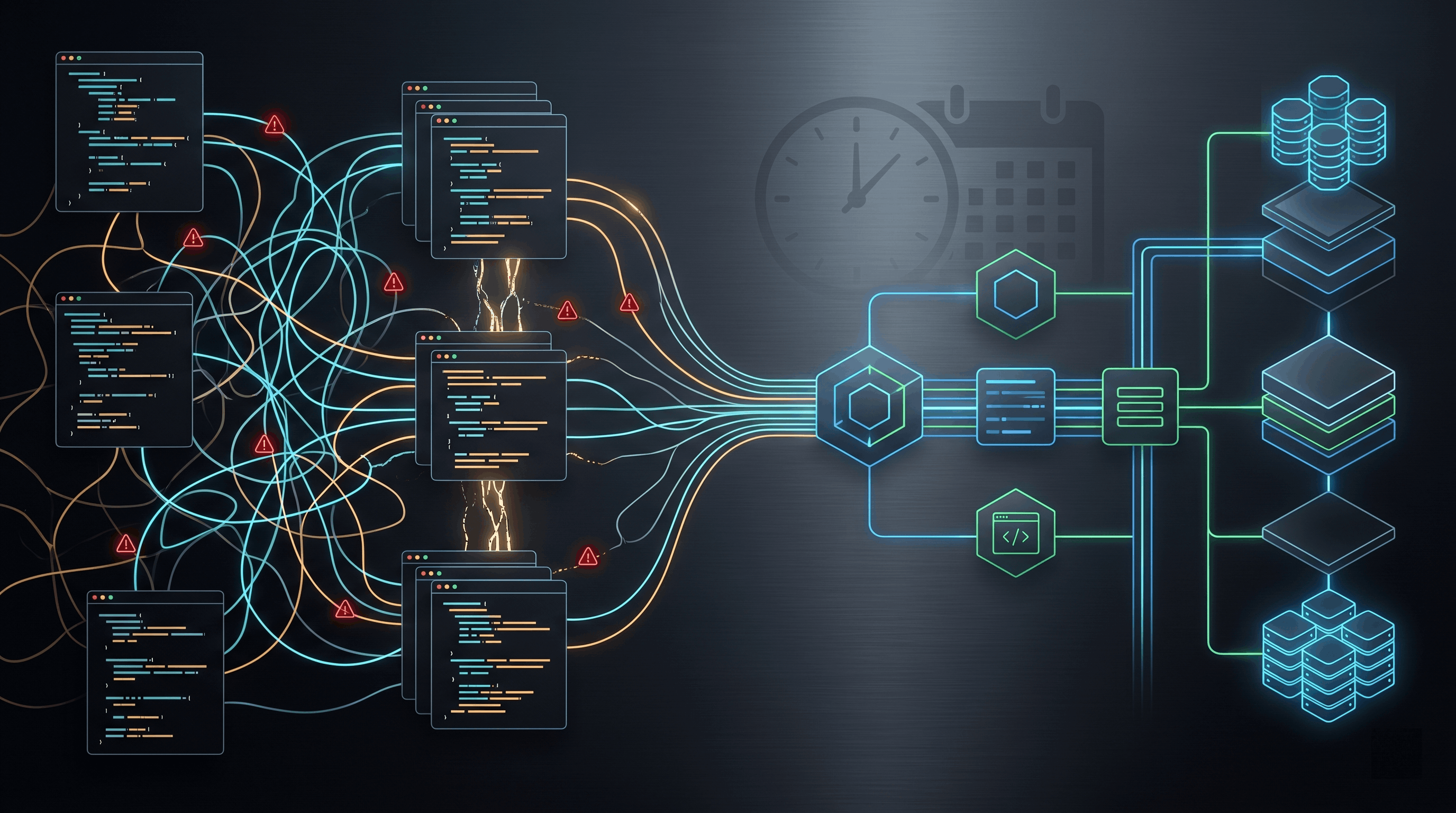
The MVP Trap: How Quick and Dirty Code Makes Every Feature Expensive
April 20269 min readQuick MVP code feels cheap until every feature ships slower—learn how founders avoid paying twice for the same product.
Rewrite or Refactor? The Decision That Burns Founder Money
May 202610 min readBefore rebuilding your app from scratch, learn when a rewrite is worth it, when refactoring wins, and the hidden costs founders miss.
Questions about something you read here, or a project you want to move forward? I work with teams on full-stack builds, AWS and serverless consolidation, migrations, and messy systems.
Contact me