
The MVP Trap: How Quick and Dirty Code Makes Every Feature Expensive
 Roy LevyApril 20269 min readProduct & delivery
Quick and dirty code feels cheap in month one.
By month six, it starts charging rent.
Not because every MVP needs enterprise architecture. It doesn't. Most early products do not need a huge system, a microservice circus, or some over-engineered architecture diagram that only exists to impress other developers.
But there is a big difference between simple and sloppy.
Simple code is focused.
Sloppy code is a trap.
And a lot of MVPs die because people confuse the two.
An MVP Is Not Permission to Build Garbage
I like MVPs.
A good MVP cuts scope. It avoids unnecessary features. It helps a founder test an idea without burning six months building a fantasy product nobody asked for.
That part is smart.
The problem starts when "MVP" becomes a permission slip for garbage. There is no clear structure, no separation of concerns, and no thought behind the data model. No reusable patterns. No attention to performance. No plan for what happens if the product actually works.
That is not lean.
That is gambling.
And the bet is always the same:
"Let's move fast now and deal with the mess later."
The funny thing is, later always arrives.
If you are building the first serious version of a product, the goal is not to turn it into a cathedral. It is to keep it small without making it brittle. That tradeoff is where senior full-stack product development actually earns its money.
The Six-Month Problem
The real cost of quick and dirty code usually does not show up on day one.
On day one, the app loads. The demo works. The founder is happy. The button does the thing.
Great.
But six months later, the product has real users, real feedback, real feature requests, and real business pressure. The first version is almost never the final version. Users ask for things. Founders learn. Markets shift. Features get killed. New ones appear.
A good codebase gives you room to move when that happens. A bad one turns every change into a fight:
- You want to add subscriptions, but payments are tangled into user logic.
- You want to add admin permissions, but roles were hardcoded as strings in five different places.
- You want better filtering, but the database was shaped around the first screen, not the actual product.
- You want analytics, but events were never modeled properly.
- You want to improve performance, but every request pulls half the system because nobody cared about query design.
Now every new feature starts with fear.
Not "How do we build this?"
But:
"What will this break?"
That is when the cheap MVP becomes expensive.
Bad Code Does Not Just Slow Developers Down
Founders often think messy code is a developer problem. It is not. Messy code becomes a product problem.
It slows down the business in ways that do not look technical at first:
- Roadmap decisions slow down because nobody knows what is safe to change.
- Sales slows down because "small" customer requests become risky.
- Hiring slows down because new developers need weeks just to understand the swamp.
- Design slows down because the UI is glued to old assumptions.
- Strategy slows down because the product can no longer move cleanly.
Bad code does not stay inside the codebase.
It leaks into the business.
The Worst Codebases Look Fast from the Outside
This is the part most people miss.
A messy MVP can look productive at first.
Features get shipped quickly because nobody is thinking about structure. Everything is hacked straight into place:
- Need a new field? Add it wherever.
- Need a new screen? Copy an old one.
- Need a new condition? Add another if.
- Need a new API? Ship it with whatever shape works today.
It feels fast.
Until the product needs to change direction.
Then every shortcut becomes a wall:
- That one copied component becomes eight slightly different versions.
- That one messy API response becomes something the frontend depends on everywhere.
- That one bad database decision becomes a migration nobody wants to touch.
- That one "temporary" workaround becomes production behavior.
Temporary code has a funny habit of becoming permanent when nobody owns the system properly.
Good MVP Code Is Not Over-Engineered
This is where people get defensive.
They hear "clean code" and think it means overbuilding.
It doesn't.
I am not talking about turning a small SaaS MVP into a corporate architecture museum. I am talking about basic professional standards: clear folders, readable logic, sane data modeling, consistent API contracts, reusable components where they actually help, validation in the right places, and performance considered before it becomes a fire.
In plain terms: code that another serious developer can open and understand.
That is not perfectionism.
That is hygiene.
You do not need a palace.
You need a building that does not collapse when you add a second floor.
Clean MVP Code Is Boring on Purpose
A good MVP codebase does not need to be impressive.
It needs to be easy to change.
That means boring decisions in the right places:
- Can you add a new feature without touching five unrelated areas?
- Can another developer understand the flow in one day?
- Can the database support the next obvious product step?
- Are API responses shaped around the product, not just today's screen?
- Is validation handled deliberately, instead of living randomly across the frontend and backend?
- Is the code boring enough to maintain?
None of this is fancy.
That is the point.
Good MVP engineering is not about showing off.
It is about making sure the product can keep moving after the first version ships.
The Real Premium Is Judgment
When you pay a senior developer, you are not only paying for typing speed. You are paying for judgment: the ability to know when to move fast and when to slow down, the ability to cut scope without cutting the product's throat, and the ability to build the first version in a way that does not punish the second version.
That matters more than people admit.
Because anyone can ship a demo with enough shortcuts.
The harder job is building something that does not collapse the moment real users start asking for changes.
Performance Is Usually Where the Lies Show Up
Performance is one of the easiest things to ignore in an MVP. Small dataset. Few users. Simple demo. Everything seems fine.
Then the product grows.
More records. More filters. More permissions. More dashboard views. More background work. More "can we also show this?" requests.
Suddenly the app feels slow and nobody knows why.
That is usually not one bug.
It is the result of dozens of small decisions nobody wanted to think about earlier.
I ran into this clearly on the Raith Rovers scouting platform. The product had thousands of player records, dense statistical data, custom profile weights, filtering, sorting, and ranking. Early deep filters were too slow to be usable. The solution was not magic. It was proper engineering: query analysis, targeted MongoDB indexes, lean query paths, caching, and precomputed scoring where it made sense. That dropped deep-filter operations from around 22 seconds to roughly 3 to 4 seconds.
That is the difference between "it technically works" and "people can actually use this."
Cheap Development Often Creates Expensive Hesitation
There is a hidden cost founders rarely calculate: hesitation.
When the codebase is fragile, every product decision becomes heavier.
You stop asking:
"What should we build?"
And start asking:
"What can this codebase survive?"
That is a terrible place to be.
The product should drive the code.
Not the other way around.
When a founder avoids a good feature because the implementation sounds scary, the codebase has become a business constraint.
That is the real cost of quick and dirty code.
Not ugly files. Not messy folders. Not developer complaints.
Lost momentum.
So What Should a Founder Actually Do?
You do not need to build the perfect system from day one.
That would be stupid.
But you do need to build with a little respect for the future.
A healthy MVP should be:
- Small, but not chaotic
- Fast to ship, but not reckless
- Flexible enough to change
- Clear enough for another developer to maintain
- Built around where the product is likely going, not only the screen needed for the first demo
The goal is not to avoid every future refactor.
That is impossible.
The goal is to avoid building a product where every future feature requires surgery.
Quick and Dirty Is Not Always Faster
Sometimes the slower-looking option is actually faster:
- Writing the cleaner abstraction now saves five copy-paste disasters later.
- Designing the API properly now avoids frontend hacks later.
- Thinking through the data model now avoids painful migrations later.
- Adding the right index now saves performance panic later.
- Keeping the code readable now saves every developer who touches it after you.
That is not gold-plating.
That is professional work.
The point of an MVP is to learn fast.
But if the codebase cannot handle what you learn, you did not build an MVP.
You built a disposable demo.
And disposable demos are fine, as long as everyone admits that is what they are.
The expensive mistake is pretending disposable code is a foundation.
Final Thought
Quick and dirty code is not cheap.
It just sends the invoice later.
And when that invoice comes, it usually does not look like "technical debt."
It looks like missed deadlines. Slow features. Scared developers. Broken releases. A roadmap nobody trusts. A product that gets harder to improve every month.
A good MVP should help you move faster as you learn.
If it makes every next step harder, it was never really cheap.
It was just badly priced.
Is Your Codebase Slowing Down the Business?
If every new feature feels like a fight and performance is dragging, the answer is not always a rewrite.
Sometimes the real work is triage: finding the parts of the system that are actually blocking progress, cleaning up what matters, and getting the product moving again.
That is the kind of work I do with startups building real products, not disposable demos.
Related posts
The Most Expensive Mistake in Software Projects (And Why Teams Miss It)
January 20264 min readTeams ship working code that misses the real problem—then pay for rework, politics, and lost months. Align on the problem before you pour concrete into code.

From Z-Scores to MongoDB Indexes: Building a Real Football Scouting Platform
April 20269 min readOn a real scouting platform, heavy MongoDB searches started around 22s—until targeted indexes, lean queries, and caching brought the worst paths down to roughly 3–4s. Read the architecture choices behind the win.
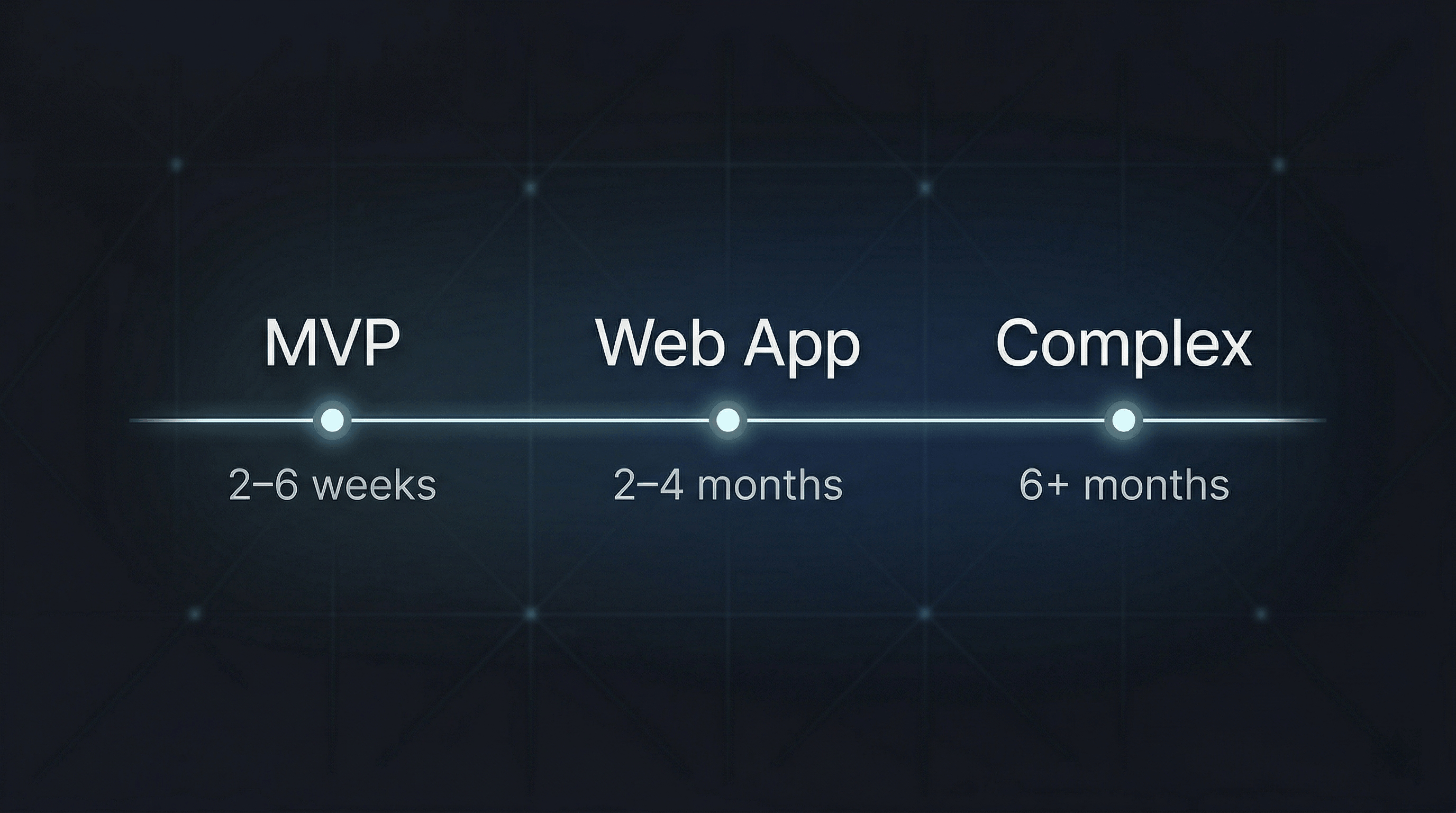
How Long Does It Take to Build a Web Application? (Real Timelines + Hidden Delays Explained)
January 20267 min readReal 2026 timelines: MVPs in weeks, solid web apps in months, complex platforms often 6+. Understand what actually stretches calendars—not typing speed—before you commit months of work.
Questions about something you read here, or a project you want to move forward? I work with teams on full-stack builds, AWS and serverless consolidation, migrations, and messy systems.
Contact me