
Angular vs React in 2026: Which One Survives AI-Written Code?
 Roy Levy7 min readSystems & architecture
I've built with both using Cursor. One writes faster. The other stays clean.
In my last post, Angular vs Next.js in 2026, I said the real tradeoff wasn't Angular vs React.
Some of you didn't love that answer.
Fair enough. Not everyone needs a full-stack framework. Plenty of teams still spin up a plain React app with Vite, connect it to an API, and ship.
So let's talk about it.
But here's the thing. In 2026, I barely write code by hand anymore (my keyboard is mostly for prompts and code review now). Cursor writes. Claude writes. I steer, review, and fix.
So the question isn't "which one is nicer to write?"
It's this:
Which one keeps your app sane when AI is writing most of it?
AI speaks fluent React
Let's start with the obvious part. AI is really, really good at React.
That makes sense. The internet is full of React code. Every model has seen millions of components, hooks, and tutorials. You ask for a feature, and the AI answers fast, confidently, and most of the time it just works.
I asked Cursor for a dynamic drag-and-drop kanban board using Tailwind and React Query, and of course a "make it look beautiful" ending. The AI spat out three clean components, wired up the state, and it worked flawlessly on the very first try.
The first few times, it felt like cheating.
Then a few weeks pass.
The wild west, now on autopilot
In my last article I said raw React often feels like the wild west. Five developers, five different systems, one app.
With AI, you don't need five developers anymore.
You need one AI and five prompts.
React gives you a lot of valid ways to do the same thing:
State? useState, Context, Zustand, Redux, or the URL.
Data fetching? useEffect, React Query, SWR, or "a custom hook I'll clean up later."
Forms? Controlled, uncontrolled, React Hook Form, Formik.
Folders? By feature, by type, or by vibes.
All of them are legit. That's exactly the problem.
Every prompt, the AI picks one. Usually whichever fits the snippet it's looking at right now. It has no memory of the decision it made yesterday, and honestly, it doesn't care.
I once spent an entire afternoon debugging a race condition, only to discover the AI had created four separate custom hooks across three files to fetch the exact same user profile endpoint over and over again.
Each piece works on its own.
Together, the app slowly stops making sense.
One component fetches in a useEffect. The one next to it uses React Query. A third one has its own little cache that nobody asked for. The state lives in three places and agrees with itself maybe 80% of the time.
And then you open a file and ask the classic question:
"Who the hell wrote this?"
You did. Well, your AI did. Same thing, legally speaking.
That's not AI-assisted development.
That's AI-assisted chaos.
Humans used to need months to create this kind of mess. AI does it over a weekend.
Angular keeps the AI on a leash
This is where Angular surprised me again. Just in the opposite direction.
AI is a little less fluent in Angular. Sometimes it reaches for older patterns, like NgModules or a wall of RxJS, when a simple signal would do the job. You notice that.
But when it writes Angular, the result looks like Angular.
One router.
One way to do dependency injection.
One way to define a component.
A clear home for services.
A CLI that generates files in the same shape every time.
The framework itself is a set of rules. The AI just doesn't have much room to get creative. And when it comes to architecture, creative is not a compliment.
Modern Angular makes it even better. Standalone components killed the NgModule ceremony. Signals made state simple to read. Zoneless is the default since v21. And Angular 22 made Signal Forms stable and OnPush the default change detection.
That matters for AI more than people think. Less boilerplate means fewer tokens, fewer places to mess up, and smaller diffs for you to review at 11pm.
Sure, you can write a rules file (.cursorrules, CLAUDE.md, whatever your tool uses) in both frameworks. But in Angular, the framework already enforces half the rules before you write a single line of instructions.
Where React still wins
This is not an "Angular good, React bad" post. React has real advantages, and some of them get stronger with AI.
The ecosystem. Whatever you need, there's a React library for it, and the AI already knows how to use it.
Hiring. More developers know React. If you're building a team, that's not a small thing.
Small apps and prototypes. A landing page, an internal tool, an MVP you might throw away next month. Angular's structure can feel like bringing a forklift to move a chair. React gets you from zero to something in minutes.
The React Compiler. Since React Compiler 1.0, a lot of the manual useMemo and useCallback juggling is handled for you. One less thing the AI can get wrong. One less thing you need to review.
So if day-one speed is what you care about most, React with AI is hard to beat.
How to make React work with AI
If you go with React (and a lot of you will), here's what I'd do.
Decide your stack before the first prompt:
- One router
- One state solution
- One data-fetching library
- One forms library
- One folder structure
Write it down in a rules file. Tell the AI to always follow it. Review every PR for drift.
Do that, and React plus AI becomes a really strong combo.
But notice what just happened.
You just rebuilt, by hand, a chunk of what Angular gives you out of the box.
So which one makes you faster?
Here's my honest answer.
React is faster on day one. The AI writes it fluently, the ecosystem is huge, and you see results right away.
Angular is faster in month six. The code still looks like one team wrote it, even when that "team" was mostly an AI. Adding a feature doesn't start with an archaeology dig.
Last time I called it structured speed vs flexible speed. With AI in the picture, I'd put it like this:
Fast to generate vs safe to maintain.
Final take
A few years ago, Angular vs React was about syntax, bundle size, and learning curves. In 2026, those gaps are way smaller than they used to be.
The new question is how much freedom you want to give the thing that's writing your code.
React gives the AI a blank canvas.
Angular gives it a blueprint.
So no, I'm still not leaving Angular (at least not entirely). But I totally get why so many people pick React, especially for version one.
Cheap code is fast to write and expensive to keep. That was true before AI. AI just made the "fast to write" part a lot faster.
So maybe the simplest way to say it:
React lets AI write more. Angular makes sure it's worth keeping.
Got an Angular app that AI has been writing for a while and it's starting to drift? That's the kind of work I take on. Here's how I work on Angular projects.
FAQ
Is Angular or React better when AI writes most of the code?
React is faster on day one: models have seen far more React code, so they write it fluently. Angular holds up better over months, because the framework allows one router, one way to do dependency injection and one component shape, so AI-written code stays consistent. Fast to generate vs safe to maintain.
Why does AI-written React code drift over time?
React offers many valid ways to do the same thing: state, data fetching, forms and folder structure each have several options. On every prompt the AI picks whichever fits the snippet in front of it, with no memory of what it chose yesterday. Each piece works, but the app ends up with three state patterns and duplicate fetching logic.
How do you keep React consistent when using AI coding tools?
Decide the stack before the first prompt: one router, one state solution, one data-fetching library, one forms library and one folder structure. Write it in a rules file such as .cursorrules or CLAUDE.md, tell the AI to always follow it, and review every PR for drift.
Related posts
5 Mistakes Teams Make When Moving to Next.js (And What Actually Matters)
March 20266 min readTeams move to Next.js expecting SEO and speed fixes—often the friction was never stack-deep. Learn what actually breaks migrations and what fixes them.
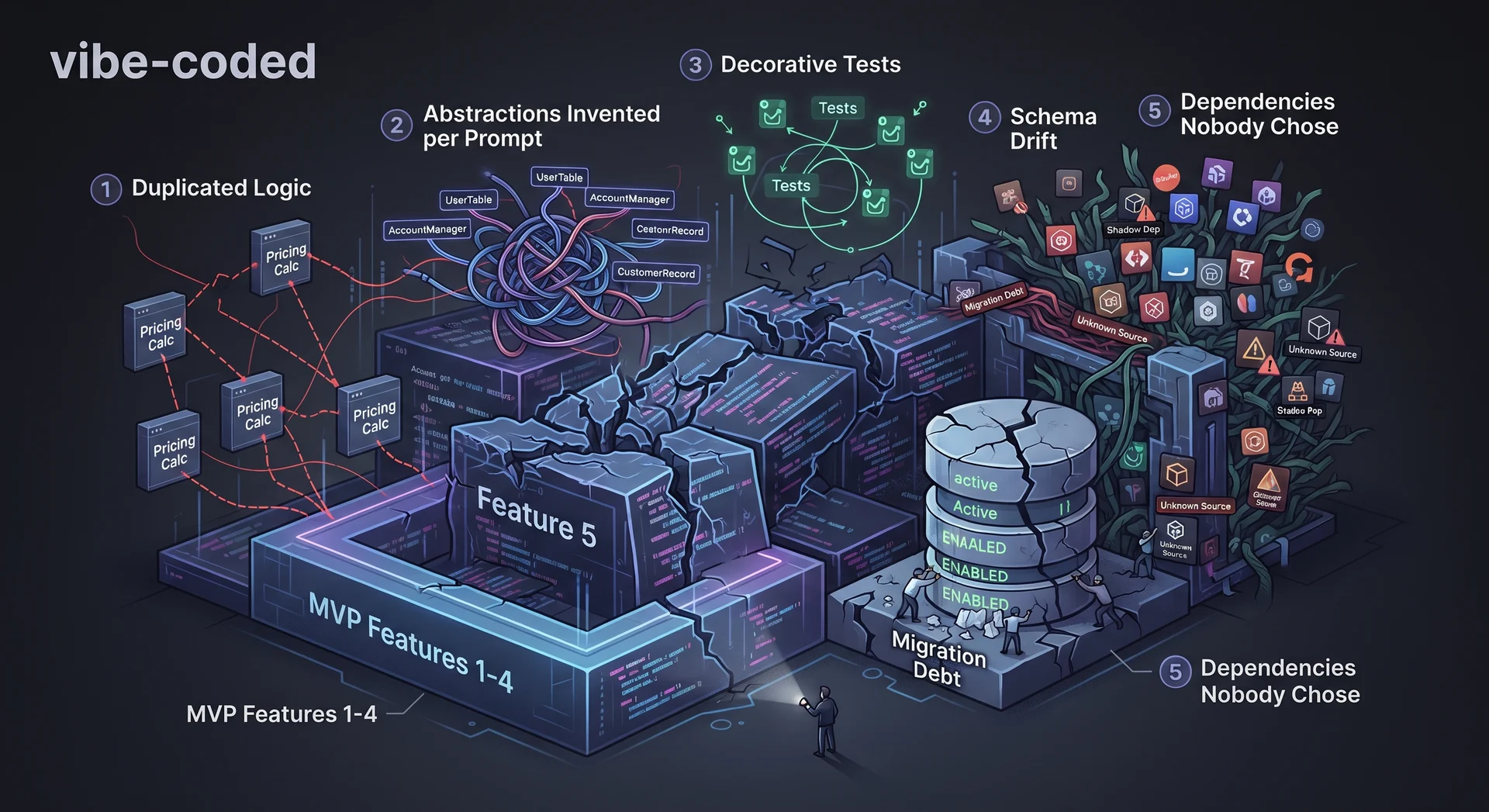
Shipped by AI, Stuck at Feature Five: What Actually Breaks in Vibe-Coded Codebases
August 202612 min readAI-generated MVPs ship fast and then stall. Here's what actually breaks — duplicated logic, schema drift, decorative tests — and how founders can diagnose it without an engineer.
The MVP Trap: How Quick and Dirty Code Makes Every Feature Expensive
April 20269 min readQuick MVP code feels cheap until every feature ships slower—learn how founders avoid paying twice for the same product.
Questions about something you read here, or a project you want to move forward? I work with teams on full-stack builds, AWS and serverless consolidation, migrations, and messy systems.
Contact me